AI models speed up particle simulations at the HL-LHC
Project: CaloDiffusion: Denoising diffusion models with geometry adaptation for high fidelity calorimeter simulation
Researchers are using innovative computing programs, called generative machine learning models, to simulate data from the upcoming High-Luminosity Large Hadron Collider. These models are faster and more efficient than traditional physics-based computing simulations, which is important given that the new collider will generate huge amounts of data from complex detectors.
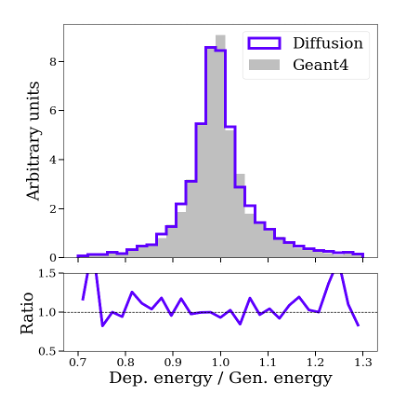
One of these programs, called CaloDiffusion, uses 3D computer models to simulate how particles interact with detectors. It belongs to a new class of machine learning models known as denoising diffusion models, which have recently become the leading approach in image generation tasks. CaloDiffusion adapts to the detector’s geometry, including its irregular structures, and produces results that closely match traditional simulations, offering a powerful and scalable solution for future collider experiments.