AI for physics, physics for AI
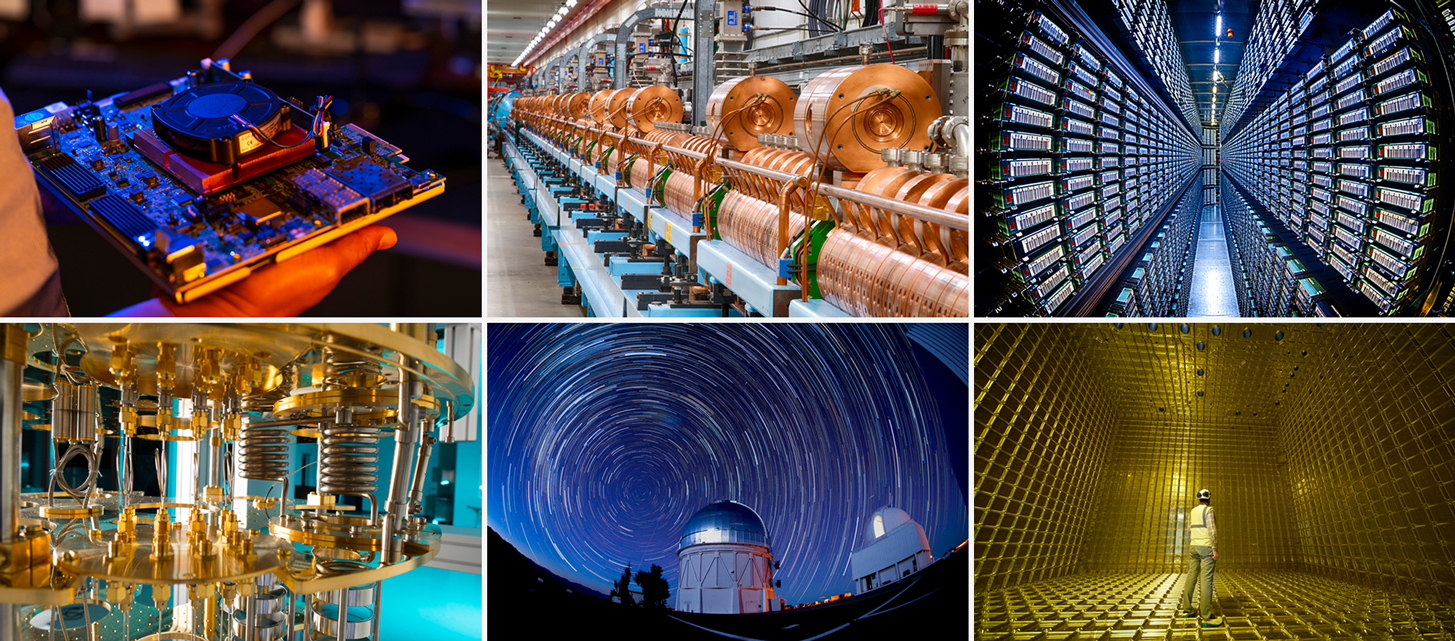
Fermilab is a world-recognized leader in particle accelerator science and technology. Its accelerators send powerful particle beams traveling at nearly the speed of light across miles of beamlines, enabling physics experiments that generate massive streams of data for scientific discovery.
With its world’s largest datasets, and complex detector and accelerator systems, the lab’s high-energy research creates unique opportunities for AI innovations. Researchers at Fermilab develop and implement AI tools to improve measurements, optimize operations and accelerate discovery.
Fermilab enhances the scientific goals of particle physics by:
- Advancing discovery in high-energy physics research
- Developing national AI capabilities that build on the challenges of particle physics and technologies
- Fostering collaboration to address interdisciplinary AI challenges and share insights with scientific and technology partners

Fermilab applies artificial intelligence to advance its mission of exploring the fundamental nature of matter, energy, space and time.
Genesis Mission
The U.S. Department of Energy has launched the Genesis Mission, a historic effort to partner national laboratories with the private sector in leveraging AI and quantum science to transform the pace and impact of U.S. scientific discovery. The Genesis Mission seeks to double the productivity and impact of American science and engineering within a decade. It will achieve this by uniting national laboratories, industry, and academia around a national platform powered by our nation’s supercomputers, AI systems, experimental facilities and unparalleled datasets.
The Genesis Mission will accelerate particle physics research, expand the ability to test new theories, and open doors to scientific advances previously out of reach. Fermilab’s leadership in AI-enabled research, quantum science, microelectronics, and the design and operation of some of the world’s most complex scientific instruments will be essential to the success of the mission. This is exactly the type of challenge Fermilab was built to meet.
Explore the range of collaborative project opportunities within the Genesis Mission at Fermilab.
Areas of application
By integrating AI throughout its research and operations, Fermilab not only propels its own scientific mission forward but also contributes to the evolution of artificial intelligence. Discover how AI plays a key role across many of the lab’s core research and mission areas.
Neutrino experiments
As the premier U.S. laboratory for neutrino research, Fermilab is using AI to expedite experiments’ workflows and enhance event reconstruction. At the heart of this effort is the Deep Underground Neutrino Experiment, an international flagship experiment bringing together scientists from over 30 countries to explore the mysteries of these elusive particles.
Accelerator research
At Fermilab, AI applications include reinforcement and online learning, efficient data collection, and automated control systems. They enable tasks such as multivariate time series forecasting for precise accelerator tuning, anomaly detection for predictive maintenance and surrogate modeling to enhance simulations. Each innovation is developed with a commitment to safety and scientific rigor.
Quantum Information Science
Fermilab is exploring machine learning to operate quantum devices and develop new complex quantum computing algorithms. Applications include using quantum data from simulations and sensing experiments, and applying AI to optimize control over quantum systems.
Smart detectors and sensors
Researchers are developing configurable detectors capable of edge computing and dynamic data collection. These adaptative systems use AI to optimize sensing, enabling real-time response and efficient bandwidth usage, which are key steps toward fully autonomous detectors.
Particle physics at colliders
At the CERN Large Hadron Collider, Fermilab plays a leading role in the Compact Muon Solenoid experiment. CMS researchers apply AI across a wide range of applications, including early-stage particle event reconstruction, pattern recognition, more efficient event generation and neural network-based simulation, and data analysis.
Astrophysics
Fermilab brings AI into the big-data era of astronomy. Researchers contribute to major surveys, such as the Dark Energy Survey, the South Pole Telescope and the NSF-DOE Vera C. Rubin Observatory. They use AI to detect and study astronomical objects and related phenomena, as well as for automation and self-driving telescope technologies.
Business operations
At Fermilab, AI streamlines business operations by providing efficient access to and intelligent analysis of extensive historical records and procedures through large language models in controlled environments. Leveraging LLMs and techniques like retrieval-augmented generation, the lab enhances information discovery and decision-making across complex datasets.